AI For Lawyers
AI Legal Document Summarizer

Every litigator knows the drill: a case file arrives as a stack of scanned PDFs, some typed, some handwritten, some stamped and signed a dozen times over, and somewhere in those 400 pages is the one clause, date, or precedent that decides the matter. Finding it used to mean hours of manual scrolling. Today, AI-powered OCR (Optical Character Recognition) is changing that entirely, turning static scanned images into fully searchable, structured legal text in seconds.
This isn't the OCR most people remember from a decade ago. Modern, AI-driven OCR doesn't just "read" characters; it understands legal structure, extracts key entities, and makes entire case files queryable the way a database is. Here's how it works, and why it's becoming essential infrastructure for legal and tax professionals in India.
What Is OCR, and Why Does It Matter for Legal Work?
OCR is the technology that converts images of text, such as scanned documents, photographed pages, and faxed filings, into machine-readable text. In legal practice, this matters enormously because so much of the profession still runs on paper: court judgments, affidavits, tax notices, contracts, and evidence bundles are frequently scanned rather than born-digital.
Without OCR, a scanned judgment is just a picture. You can't search it, copy text from it, or ask an AI tool to summarize it. With OCR, that same document becomes text a computer can index, search, analyze, and cross-reference against thousands of other filings.
Why Legal Documents Are Harder for OCR Than Ordinary Text
Generic OCR tools, the kind built into phone cameras or basic PDF software, struggle badly with legal documents for a few specific reasons:
Poor scan quality: Court records are often photocopied multiple times, faxed, or scanned on outdated equipment, producing faded or skewed text.
Dense, non-standard layouts: Judgments mix paragraph numbering, footnotes, cause-title blocks, and citation formats that confuse layout-based OCR engines.
Stamps, seals, and handwritten annotations: Court stamps, judicial signatures, and handwritten endorsements overlap with printed text.
Legal-specific vocabulary: Standard OCR models aren't trained on terms like "suo motu," "res judicata," or statute citation formats, leading to frequent misreads.
Multilingual content: Indian legal documents often mix English with Hindi or regional-language text within the same filing.
This is exactly where AI-powered OCR, as opposed to basic OCR, earns its value.
How AI Turns Scanned Case Files Into Searchable Text
AI-driven OCR pipelines go several steps beyond simple character recognition:
1. Image Preprocessing
Before any text extraction happens, AI models clean up the scan, correcting skew, removing noise, enhancing contrast, and isolating text regions from stamps or signatures.
2. Context-Aware Character Recognition
Rather than reading character-by-character in isolation, modern OCR models use language context to resolve ambiguous characters, the way a human reader infers a smudged word from the sentence around it. This is where legal-domain training matters: a model trained on case law and statutes recognizes "Hon'ble," "petitioner," and section citations far more accurately than a generic model.
3. Structural Recognition
Advanced systems don't just extract a wall of text; they recognize the structure of a legal document: cause title, parties, case number, paragraph numbering, headings, and signature blocks. This turns a flat scan into a structured record you can navigate.
4. Entity and Citation Extraction
AI models can identify and tag key entities automatically, including party names, dates, statute references, and case citations, making it possible to jump directly to "every mention of Section 138" or "every date referenced in this bundle" instead of reading linearly.
5. Indexing for Search
Once text is extracted and structured, it's indexed, meaning you can now search across an entire case file, or an entire case library, in plain language, instead of opening document after document.
Why This Matters for Lawyers and CAs
The practical impact of AI OCR on legal and tax workflows is significant:
Faster case preparation: Search a 4,000-page case bundle for a specific clause or precedent in seconds instead of hours.
Better due diligence: Cross-reference dates, parties, and clauses across dozens of contracts or filings without manual review.
Accurate document analysis and summaries: Once text is extracted, AI can generate case timelines, summaries, and lists of dates automatically.
Reliable tax notice responses: CAs handling income tax notices can extract exact figures, sections cited, and deadlines from scanned notices instantly, rather than retyping them.
Searchable litigation history: Firms managing large case volumes can build a searchable internal archive instead of relying on folder-by-folder memory.
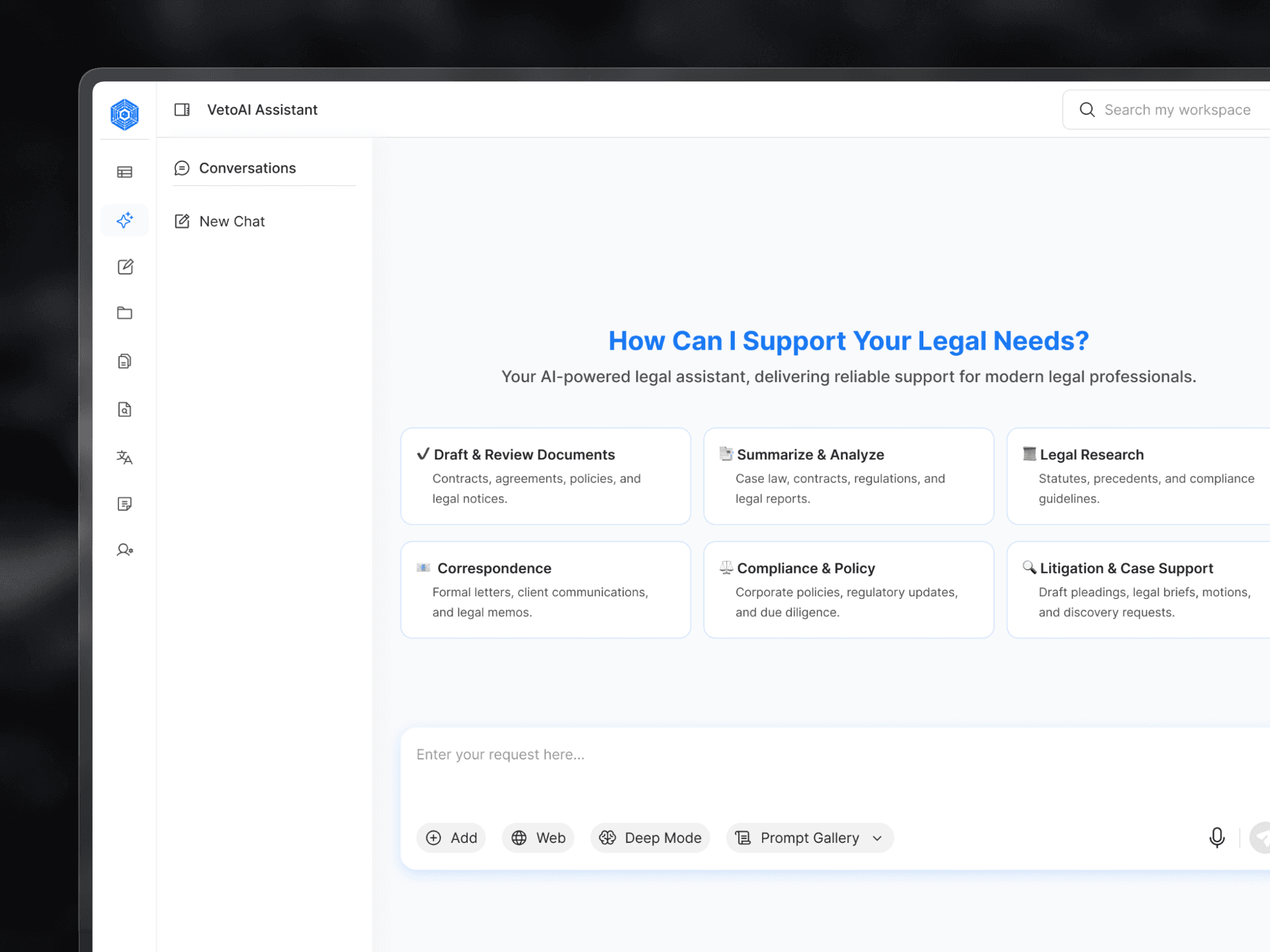
This is precisely the kind of workflow VetoAI was built around. The platform combines OCR-driven document processing with AI case law research and drafting, so a scanned judgment or tax notice doesn't just become readable text, but becomes something you can immediately question, summarize, and act on, complete with source-linked citations back to the original document. For a lawyer building a writ petition or a CA responding to a notice under deadline, that's the difference between OCR as a standalone utility and OCR as part of an actual legal workflow.
What to Look for in an AI OCR Tool for Legal Work
Not all OCR tools are equal, and for legal use specifically, a few things matter more than raw accuracy claims:
Legal-domain training: Has the model been trained on case law, statutes, and Indian court formats, or is it a general-purpose OCR engine?
Handling of Indian court documents specifically: Support for regional-language mixing, court stamps, and standard Indian filing formats (cause lists, vakalatnamas, tax notices).
Structured output, not just raw text: Does it preserve paragraph numbering, headings, and document structure, or dump everything as one text block?
Source traceability: Can every extracted fact or summary be traced back to the exact page and line in the original scan? This matters both for courtroom reliability and for avoiding the citation-fabrication risks generic AI tools are known for.
Data security: Legal and tax documents are confidential by definition. Look for enterprise-grade encryption and a clear no-training-on-your-data policy.
The Bigger Shift: From Paper Archives to Queryable Knowledge
The real value of AI OCR isn't just "faster reading." It's converting years of paper-bound case history into a searchable, structured knowledge base. A law firm's scanned archive of past judgments, contracts, and filings becomes an asset it can actually query, rather than a storage liability. For Indian legal and tax professionals still managing large volumes of scanned records, that shift, from static paper to searchable, AI-readable text, is quickly becoming table stakes rather than a nice-to-have.
Frequently Asked Questions
Is AI OCR accurate enough for court filings?
Modern AI OCR models trained specifically on legal documents achieve high accuracy on printed text, though handwritten annotations and poor-quality scans still benefit from a quick human review pass before filing.
Can AI OCR handle documents in Hindi or regional languages mixed with English?
Yes. AI models trained for Indian legal use are built to handle multilingual documents, unlike most generic OCR tools.
Does OCR replace the need to read the original document?
No. OCR makes documents searchable and analyzable, but for anything filed in court, the original scanned document remains the authoritative record. AI output should always be traceable back to it.
Author :
Satyajit Mane
Product / UX Researcher

Get started with legal AI
Ready to Work Smarter With Legal AI?