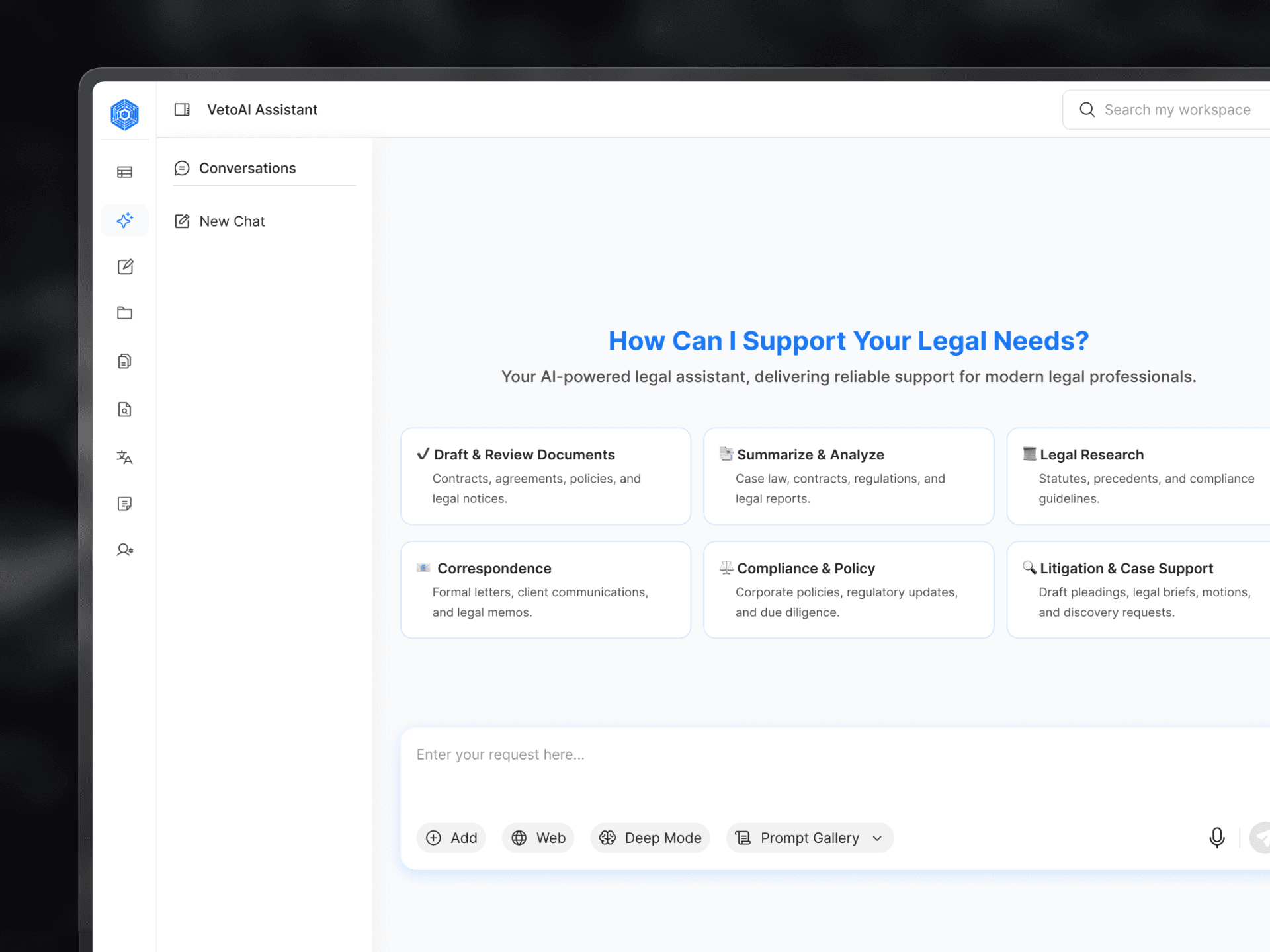
AI For Lawyers
VetoAI Law Firm

A Practical Guide to AI-Powered Legal Drafting and Document Workflows
How much of a lawyer's day goes into drafting documents that follow almost the same structure, format and language—again and again?
From legal notices and affidavits to petitions, agreements and written submissions, document preparation is an essential part of legal practice.
But drafting every document from scratch can consume valuable time, especially when lawyers handle multiple clients and matters simultaneously.
What if technology could help organise case facts, generate structured first drafts and simplify repetitive documentation—while allowing lawyers to retain complete control over legal accuracy?
That is the promise of legal document automation.
With the advancement of Artificial Intelligence, legal document automation is moving beyond simple templates. Modern AI-powered tools can assist with analysing information, structuring legal content, generating initial drafts and reviewing lengthy documents.
Let's understand how this technology works and how Indian lawyers can use it in their everyday practice.
1. What Is Legal Document Automation?
Legal document automation refers to the use of technology to simplify and standardise the creation, editing, review and processing of legal documents.
Traditionally, lawyers prepare documents by referring to previous drafts, copying relevant clauses, entering matter-specific information and manually adjusting the structure and language.
This process can be repetitive and time-consuming.
Document automation helps simplify these tasks through digital templates, structured information inputs, reusable content and automated workflows.
AI-powered document automation takes this a step further by helping legal professionals:
Organise facts and information from case records.
Generate structured legal drafts.
Summarise lengthy documents.
Extract important clauses and details.
Identify potentially relevant legal issues.
Translate legal text.
Review and compare documents.
The goal is not to automate legal judgement. It is to reduce repetitive drafting and information-processing work.
2. Why Traditional Legal Drafting Can Be Time-Consuming
Legal drafting requires precision, consistency and a clear understanding of the relevant facts and applicable law.
However, lawyers often face practical challenges when preparing documents.
A. Repetitive drafting
Many legal documents follow established structures. Recreating similar formats for different matters can involve repetitive work.
B. Manual information extraction
Before drafting a petition or notice, lawyers may need to review several documents to identify the relevant facts, dates, parties and supporting information.
C. Formatting and consistency issues
Maintaining consistent formatting, headings, terminology and document structure across multiple drafts can require additional effort.
D. Managing multiple versions
When documents go through several rounds of revision, keeping track of the latest version and identifying changes can become difficult.
E. Research and citation integration
Legal documents frequently require supporting statutory provisions and judicial precedents. Identifying and incorporating relevant authorities requires careful research and verification.
These challenges make legal document automation a valuable area of legal technology.
3. How AI Is Changing Legal Document Automation
Traditional automation primarily relies on predefined templates and information fields.
AI-powered document automation introduces capabilities that help lawyers work with unstructured information and generate context-aware drafts.
Here are some important applications.
1. AI-Assisted Legal Drafting
AI can help lawyers prepare initial drafts of legal documents based on matter-specific instructions and information.
Depending on the tool and workflow, this can include:
Legal notices.
Petitions.
Applications.
Affidavits.
Agreements.
Written statements.
Draft legal replies.
For example, a lawyer may provide the relevant facts, parties' details, legal issues and drafting instructions.
An AI drafting assistant can use this information to prepare a structured first draft for review and refinement.
The lawyer remains responsible for checking the facts, legal provisions, language and final structure.
2. Automated Extraction of Case Facts
Legal drafting often begins with collecting relevant information from multiple documents.
AI-powered document analysis can help identify:
Names of parties.
Dates and events.
Important factual statements.
Relevant contractual clauses.
Case references.
Supporting information.
This can reduce the need to manually search through lengthy documents before beginning a draft.
3. Legal Document Summarisation
When lawyers receive lengthy judgments, agreements or case records, reviewing every page may take considerable time.
AI summarisation can help create structured overviews of documents and identify key information.
These summaries can support the initial drafting process, although the original document should always be reviewed for accuracy and context.
4. AI-Powered Document Comparison
Comparing multiple versions of legal documents is an important part of contract review and legal drafting.
AI-assisted comparison can help identify changes in wording, clauses, obligations and other relevant information.
This can make document review more structured and help lawyers focus on significant differences.
5. Legal Translation
Legal professionals may encounter documents written in different Indian languages or English.
AI-assisted translation can help convert legal text into another language for easier review and understanding.
However, legal terminology, context and the accuracy of translated clauses should be independently checked before formal use.
6. OCR and Smart Document Processing
Many legal records are available as scanned PDFs or image-based documents.
Optical Character Recognition (OCR) helps convert these documents into machine-readable text.
Once converted, the information can be searched, analysed and used in further document workflows.
This is particularly useful when working with older case files and scanned supporting records.
4. Benefits of Legal Document Automation for Indian Lawyers
Legal document automation can improve efficiency across several areas of legal practice.
Reduced repetitive work
AI-assisted drafting can help prepare structured first drafts and reduce repeated manual formatting and information entry.
Improved consistency
Standardised drafting workflows can help maintain consistent document structures and terminology.
Faster document review
Summarisation and information extraction can help lawyers identify relevant information more quickly.
Better use of existing documents
OCR and document analysis make it easier to work with scanned records and lengthy case files.
More organised drafting workflows
Structured drafting and document interaction can help legal professionals manage the information required for preparing documents.
More time for legal analysis
By reducing repetitive work, lawyers can spend more time reviewing legal issues, refining arguments and developing case strategy.
5. Practical Examples of Legal Document Automation
Let's look at how automation can support common legal drafting activities.
Example 1: Preparing a Legal Notice
Traditional approach:
A lawyer reviews client information, collects relevant facts, refers to previous notices and prepares a new draft manually.
AI-assisted approach:
The lawyer provides the relevant facts and instructions. An AI drafting assistant can help organise the information and prepare an initial notice structure.
The lawyer then reviews the recipient details, factual allegations, legal grounds and relief sought before approving the final notice.
Example 2: Drafting a Petition
Traditional approach:
The lawyer reviews case records, identifies the relevant events, organises the facts and prepares the petition.
AI-assisted approach:
The lawyer can use document analysis to extract relevant information, prepare a timeline and generate a structured initial draft based on the supplied facts and instructions.
The final petition must be reviewed for applicable law, procedural requirements, jurisdiction, factual accuracy and supporting authorities.
Example 3: Reviewing Agreements
Traditional approach:
The lawyer reads the agreement, identifies important clauses and manually records potential concerns.
AI-assisted approach:
AI document analysis can help summarise clauses, extract obligations and highlight provisions that may require closer review.
The lawyer evaluates the contractual implications and determines the appropriate revisions.
Example 4: Preparing a List of Dates and Events
Traditional approach:
The lawyer reviews multiple documents and manually records dates and corresponding events.
AI-assisted approach:
An AI timeline tool can extract dates and associated events and arrange them chronologically.
The lawyer verifies the entries against the original documents before using the list in a legal submission.
6. What Should Lawyers Look for in Legal Document Automation Software?
Choosing the right software requires more than evaluating how quickly it generates a draft.
Here are seven important considerations.
1. Drafting flexibility
The platform should support different document types and allow matter-specific drafting instructions.
2. Document analysis
The ability to analyse uploaded legal records and extract relevant facts can make drafting more efficient.
3. Indian legal context
For Indian lawyers, the tool should support relevant Indian legal terminology, legislation and judicial references.
4. Citation support
Where drafts contain legal authorities, lawyers should be able to access and verify the underlying sources.
5. Document export
Practical export options such as DOCX and PDF make it easier to review and continue working on drafts.
6. Data privacy
Lawyers should examine how confidential client information is stored, processed and protected.
7. Human review and control
Every AI-generated document should remain editable and subject to the lawyer's independent review and approval.
7. How VetoAI Helps Simplify Legal Drafting and Document Workflows
VetoAI is an AI-powered legal workspace designed for India's legal and compliance professionals.
It brings together AI-assisted legal drafting, case law research, document analysis, OCR, summaries and case preparation capabilities.
Here is how its features support legal document workflows.
AI-Powered Legal Drafting
VetoAI helps lawyers prepare structured drafts of legal notices, agreements, petitions and other legal documents using matter-specific instructions.
Document Analysis and Summarisation
Upload legal documents and use AI to understand important facts, extract information and generate structured summaries.
Source-Linked Legal Research
Research relevant Supreme Court and High Court judgments and review source-linked legal references that support further drafting and legal analysis.
Generating Legal Grounds and Arguments
Use AI assistance to explore potential legal grounds and structure arguments based on the facts and instructions provided.
List of Dates and Timeline Generation
Extract important dates and events from case records to help organise information for legal drafting and court preparation.
OCR and Document Processing
Convert scanned legal records into searchable text for easier analysis and further use.
Translation and Document Interaction
Translate legal text and interact with uploaded documents through contextual questions and answers.
By combining these workflows, VetoAI helps lawyers move from document review and legal research towards structured, draft-ready outputs.
Importantly, AI-generated drafts are starting points for professional review, not substitutes for the lawyer's final legal judgement.
8. Is Legal Document Automation Replacing Lawyers?
One common concern surrounding AI in legal practice is whether automated drafting will reduce the need for lawyers.
The more realistic perspective is that legal document automation changes how lawyers perform certain tasks rather than removing the need for legal expertise.
AI can assist with organising information, preparing initial drafts, summarising records and identifying relevant material.
But it cannot independently take responsibility for:
Understanding the complete client relationship.
Making strategic litigation decisions.
Evaluating the credibility of evidence.
Interpreting complex legal provisions.
Determining the best legal remedy.
Approving the final legal document.
The lawyer remains central to the entire process.
The future of legal drafting is therefore likely to involve a combination of AI-assisted productivity and human legal expertise.
Frequently Asked Questions
1. What is legal document automation?
Legal document automation uses software and AI to simplify the creation, editing, analysis and processing of legal documents.
2. How does AI help with legal drafting?
AI can help organise case facts, structure documents, generate initial drafts, summarise records and support legal research. Lawyers must review and verify the final document.
3. Which legal documents can be automated?
Depending on the software and workflow, AI can assist with legal notices, petitions, agreements, affidavits, applications, written statements and other legal documents.
4. Is AI legal drafting reliable?
AI can provide useful drafting assistance, but its outputs may contain factual or legal inaccuracies. Every draft should be reviewed against the original facts, applicable laws and verified legal authorities.
5. What is the difference between document templates and AI document automation?
Traditional templates use predefined structures and information fields. AI document automation can additionally analyse information, understand instructions and assist in generating context-aware content.
6. Can individual advocates use legal document automation?
Yes. Individual advocates can use AI-assisted drafting and document analysis to simplify repetitive work, organise information and prepare initial drafts.
7. How can VetoAI help with legal document automation?
VetoAI supports AI-assisted legal drafting, document analysis, case law research, summarisation, timeline generation, OCR and document interaction for legal professionals in India.
Conclusion
Legal drafting has always required precision, legal knowledge and careful attention to detail. But it does not mean every repetitive task must continue to be performed manually.
Legal document automation gives lawyers an opportunity to simplify routine drafting, organise case information and improve document workflows.
With AI-powered tools, legal professionals can reduce repetitive work while maintaining control over legal reasoning, accuracy and final document approval.
The future is not about allowing machines to practise law. It is about enabling lawyers to use technology to work more efficiently and focus on the parts of legal practice that require their expertise.
VetoAI brings AI-assisted legal research, document analysis and structured drafting together to support a more efficient legal workflow.
Explore VetoAI and discover how AI can support your everyday legal drafting and document preparation.
Author :
Satyajit Mane
Product / UX Researcher

Get started with legal AI
Ready to Work Smarter With Legal AI?