Legal Research Tools

Legal research is one of the most valuable skills every legal professional develops throughout their career. Whether you’re preparing for litigation, drafting a legal opinion, conducting due diligence, or advising a client, the quality of your research directly influences the strength of your legal arguments.
Yet, legal research has become increasingly challenging. Every year, thousands of judgments are delivered across the Supreme Court, High Courts, tribunals, and regulatory bodies. New legislation is introduced, existing laws are amended, and judicial interpretations continue to evolve. Navigating this growing body of legal information requires both time and expertise.
Many lawyers spend hours searching through legal databases, opening multiple judgments, and filtering irrelevant results before finding the authorities they actually need. Fortunately, legal research does not have to be this difficult. By following a structured research process and leveraging modern AI-powered legal research tools, legal professionals can spend less time searching and more time analysing the law.
In this guide, you’ll learn how to start legal research effectively, avoid common research mistakes, and discover how AI is transforming the way lawyers conduct legal research.
What is Legal Research?
Legal research is the process of identifying, interpreting, and applying legal authorities to answer a legal question or resolve a legal issue. It involves analysing statutes, judicial decisions, regulations, notifications, and other authoritative legal sources to build well-supported legal arguments.
An effective legal research process typically includes:
Understanding the legal issue
Identifying applicable statutes
Finding relevant case laws
Reviewing judicial precedents
Analysing legal reasoning
Applying legal principles to the facts of the matter
The goal is not simply to find judgments. It is to identify the most relevant and authoritative legal sources that support your analysis.
Step 1: Clearly Define the Legal Issue
Every successful legal research project begins with a clear understanding of the legal issue.
Before opening a legal database, ask yourself:
What is the dispute?
Which area of law applies?
What legal question needs to be answered?
Which jurisdiction is relevant?
For example, instead of searching for:
Employment Law
Frame your research as:
Can an employer terminate an employee without conducting a domestic enquiry under Indian labour laws?
The more specific your legal question, the more focused and productive your research will be.
Step 2: Identify the Relevant Legal Concepts
Once you’ve defined the issue, identify the legal concepts associated with it.
For an employment dispute, your concepts may include:
Wrongful termination
Domestic enquiry
Principles of natural justice
Employee misconduct
Industrial Disputes Act
Labour Court
These concepts provide a starting point for research.
However, they also highlight one of the biggest limitations of traditional legal databases. Courts often describe similar legal principles using different terminology. As a result, keyword-based searches can overlook highly relevant judgments.
Step 3: Start with Primary Legal Sources
Strong legal research begins with authoritative legal sources.
Start by identifying the governing legislation.
Depending on your matter, this may include:
Bharatiya Nyaya Sanhita
Companies Act
Arbitration and Conciliation Act
Consumer Protection Act
Income Tax Act
Next, review judicial precedents that interpret these statutes, including:
Supreme Court judgments
High Court decisions
Tribunal orders
Constitution Bench rulings
Finally, examine any applicable rules, regulations, or government notifications issued under the legislation.
Building your research on primary legal authorities creates a strong foundation for legal analysis.
Where Traditional Legal Research Becomes Difficult
Up to this point, the research process seems straightforward. In practice, however, this is where many lawyers lose valuable time.
A lawyer identifies the legal issue, searches a few keywords, opens several judgments, realises they are not relevant, changes the search terms, and repeats the process multiple times. Hours pass before meaningful legal analysis even begins. The challenge is not the lack of legal information. It is the way traditional legal databases retrieve it. Most research platforms rely heavily on keyword matching. Unfortunately, courts do not always use identical terminology when discussing the same legal principle.
Consider this research question:
Can an employer terminate an employee without conducting a domestic enquiry?
A traditional search may require several keyword combinations such as:
Domestic enquiry
Wrongful termination
Natural justice
Employee misconduct
Labour law
Even after multiple searches, important judgments may still be missed because they use different language. This is where Artificial Intelligence is changing legal research.
Research the Way Lawyers Think with VETOAI
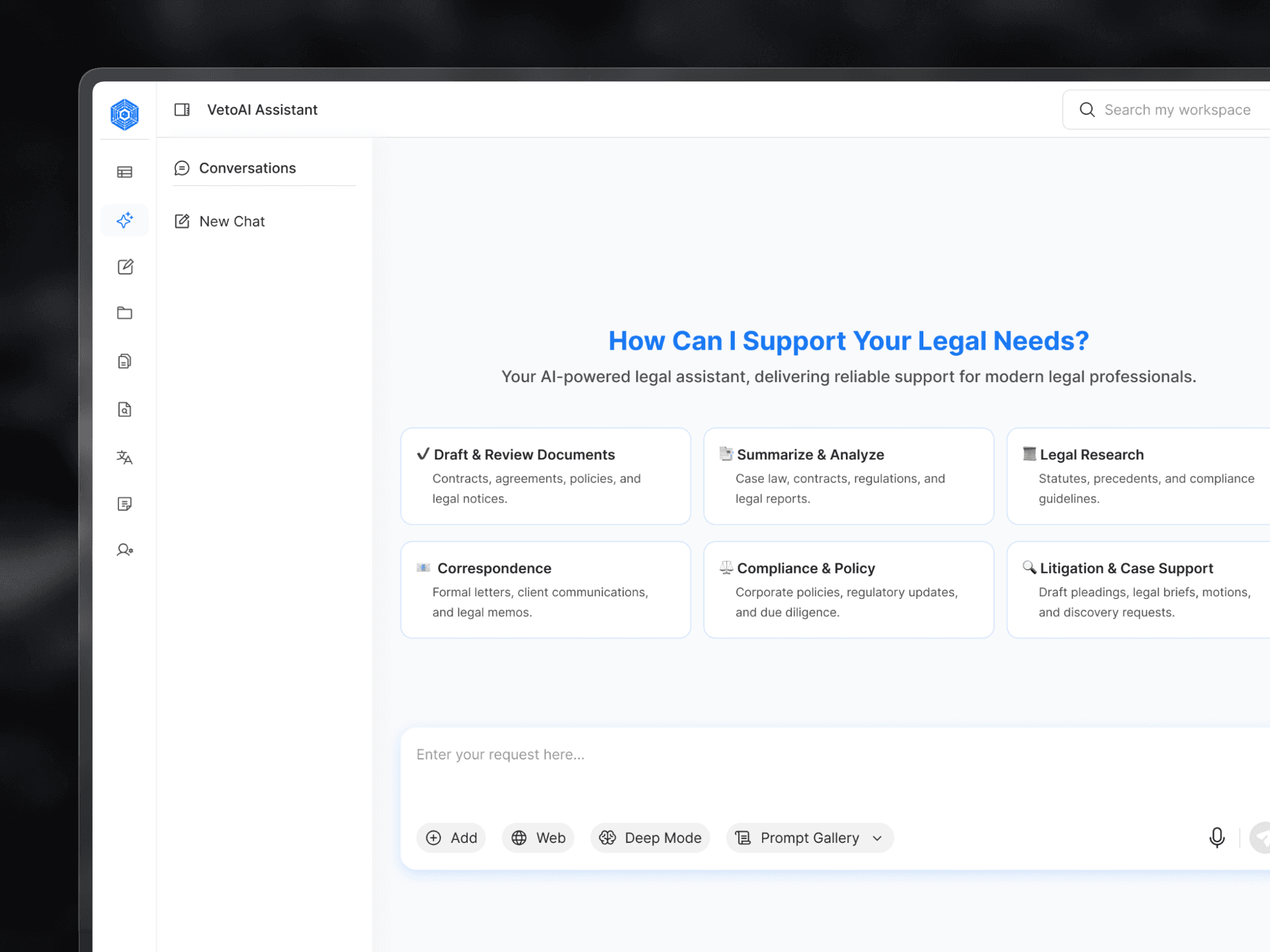
Lawyers think in legal issues, not keywords. VETOAI is designed around that principle. Instead of forcing you to guess the right search terms, VETOAI allows you to ask legal questions in natural language, just as you would discuss a case with a senior colleague.
For example:
Can an employer terminate an employee without conducting a domestic enquiry?
Instead of matching only keywords, VETOAI analyses the legal issue, understands the context behind your query, and retrieves relevant authorities based on legal principles.
This allows you to move from searching to analysing much faster. Whether you are preparing for litigation, drafting a legal opinion, conducting due diligence, or studying for examinations, VETOAI helps simplify one of the most time-consuming parts of legal practice.
Why VETOAI Makes Legal Research Faster
Traditional legal research often requires you to:
Try multiple keyword combinations
Open dozens of judgments manually
Filter irrelevant search results
Connect related precedents yourself
Spend hours validating whether you’ve found the strongest authorities
With VETOAI, you can:
Search using natural language
Discover contextually relevant case laws
Find connected precedents more efficiently
Reduce repetitive manual research
Spend more time analysing legal issues instead of locating documents
Rather than replacing legal expertise, VETOAI enhances it by helping legal professionals work more efficiently while maintaining complete control over their legal analysis.
Step 4: Review Multiple Precedents
Finding one judgment is rarely sufficient.
Strong legal research requires understanding how courts have interpreted a legal issue over time.
Review:
Landmark judgments
Recent decisions
Conflicting High Court rulings
Constitution Bench decisions
Cases that cite earlier judgments
Pro Tip: Instead of manually tracing related cases, AI-powered research platforms like VETOAI can help surface connected precedents, making it easier to understand the evolution of a legal principle.
Step 5: Analyse Rather Than Collect
Legal research is not about collecting as many judgments as possible. It is about identifying authorities that genuinely strengthen your legal argument.
When reading a judgment, focus on:
Facts of the case
Legal issue before the court
Ratio decidendi
Judicial reasoning
Final decision
Relevance to your matter
A carefully analysed judgment is often more valuable than dozens of loosely related cases.
Step 6: Verify That the Law is Current
The law evolves continuously.
Before relying on any authority, confirm:
Has the statute been amended?
Has the judgment been overruled?
Has a larger bench taken a different view?
Are there more recent Supreme Court decisions?
Keeping your research current is essential for preparing reliable legal opinions and court submissions.
Step 7: Organise Your Research
As your research progresses, organise your findings systematically.
Maintain notes under headings such as:
Legal issue
Relevant statutes
Key judgments
Important observations
Supporting precedents
Counterarguments
Practical conclusions
Well-organised research saves considerable time during drafting, client advisory, and courtroom preparation.
Best Practices for Effective Legal Research
To consistently improve your legal research:
Clearly define the legal issue before beginning your search.
Use specific legal questions instead of broad topics.
Start with authoritative legal sources.
Verify that statutes and judgments remain current.
Review multiple precedents before reaching conclusions.
Organise research in a structured manner.
Use AI-powered legal research tools to reduce repetitive research tasks and improve efficiency.
Great Legal Research Begins with Asking Better Questions
The best legal researchers are not necessarily the ones who read the most judgments. They are the ones who identify the right legal authorities quickly, understand the principles behind them, and apply those principles effectively. As legal information continues to grow, traditional keyword-based research is becoming increasingly inefficient. AI-powered legal research is helping lawyers spend less time searching and more time thinking.
VETOAI combines advanced artificial intelligence with legal expertise to help lawyers, law firms, in-house counsel, and law students conduct legal research more efficiently. By understanding legal context instead of relying solely on keywords, it enables users to discover relevant authorities faster and build stronger legal arguments with greater confidence.
Whether you are preparing for court, drafting legal opinions, conducting due diligence, or learning the law, VETOAI helps you research smarter so you can focus on delivering better legal outcomes.
The future of legal research is not about replacing lawyers. It is about empowering them with better technology.
Author :
Avika Grover
Innovator @VetoAI | Litigation & Dispute Resolution

Get started with legal AI
Ready to Work Smarter With Legal AI?