VetoAI Law Firm
Legal Research Tools

In India’s legal system, language can often become an invisible barrier to justice. Every day, lawyers deal with FIRs, witness statements, police records, case diaries, contracts, and court filings written in multiple regional languages. A criminal matter filed in Hindi may later require arguments in English before a High Court. A land dispute in Tamil Nadu may involve decades-old records written in Tamil, Telugu, or even handwritten formats.
For many advocates, legal translation is no longer just administrative work — it directly affects case preparation, client communication, and courtroom efficiency.
The challenge becomes even bigger when lawyers handle urgent filings or prepare documents for higher courts. Translating complex legal terminology manually takes time, increases operational costs, and sometimes creates interpretation errors that can affect legal strategy.
This is where modern AI-driven platforms like vetoai are changing how Indian legal professionals work.
Why Legal Translation Matters in Indian Litigation
India is one of the most linguistically diverse countries in the world. Court records and police documents frequently move between Hindi, English, Marathi, Bengali, Tamil, Kannada, Punjabi, and other regional languages.
A lawyer handling a criminal matter may need to:
Translate FIR copies into English
Review witness statements from another state
Understand local police records quickly
Prepare translated annexures for High Court filings
Analyze a Supreme Court case connected to regional documents
Traditional legal document translation usually involves manual drafting, external translators, or repeated proofreading cycles. While human review remains essential, the process itself often delays legal research and drafting timelines.
For litigation lawyers, especially those managing multiple hearings daily, speed matters.
The Growing Need for Legal Translation Online
The Indian legal industry is rapidly moving toward digital workflows. E-filing systems, scanned
PDFs, online hearings, and digital evidence are now common across courts.
As legal practice becomes more technology-driven, lawyers increasingly prefer legal translation online instead of relying entirely on offline document handling.
However, standard translation software often struggles with legal terminology. Generic AI tools may mistranslate procedural phrases, police terminology, or court-specific language. In legal practice, even small wording mistakes can create confusion.
For example:
“Bail application” and “anticipatory bail” cannot be treated as interchangeable phrases
FIR translation requires context-sensitive accuracy
Legal notices contain structured language that ordinary translators may misinterpret
Court orders often include procedural terminology unique to Indian litigation
This is why legal professionals now require AI systems specifically designed for legal workflows rather than general-purpose translation apps.
How VetoAI Helps Indian Lawyers Work Faster
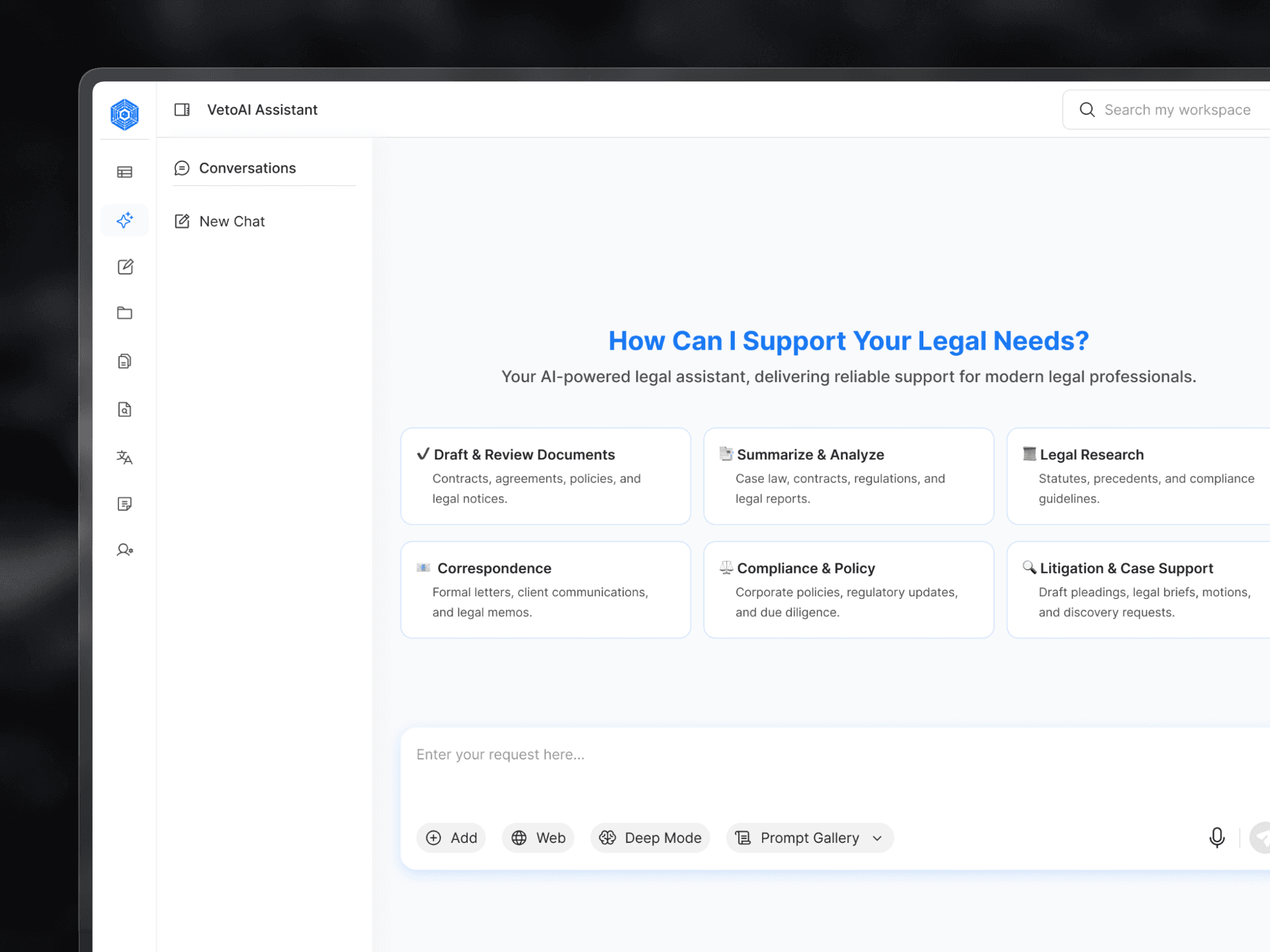
Vetoai is built for legal professionals who want faster drafting, research, and document handling without compromising legal understanding. Instead of functioning like a basic translator, VetoAI supports legal workflows by helping advocates process court-related documents more efficiently.
Lawyers can use the platform for:
Legal document translation
FIR translation
Case summary preparation
Draft assistance
Multilingual legal understanding
Faster legal research support
This becomes especially valuable in litigation-heavy practices where advocates regularly handle police files, case records, and translated annexnures.
Imagine receiving a lengthy FIR in Hindi minutes before a hearing. Instead of manually translating every paragraph, a lawyer can quickly review translated content, identify key allegations, and focus on legal strategy.
The real advantage is not just translation speed — it is legal productivity.
AI-Powered Legal Translation Tool for Modern Litigation
An AI-powered legal translation tool can significantly reduce the repetitive workload involved in multilingual case handling.
Indian advocates often spend hours:
Reading scanned records
Comparing translated copies
Explaining documents to clients
Preparing court-ready versions
Cross-checking procedural language
With AI assistance, the initial processing becomes much faster.
This allows lawyers to focus more on:
Case analysis
Cross-examination planning
Legal interpretation
Client advisory work
Courtroom preparation
Importantly, AI should support legal reasoning — not replace it.
The final legal interpretation, drafting decisions, and courtroom arguments must always remain under advocate supervision. Technology works best when it enhances professional judgment rather than attempting to replace it.
FIR Translation Is Becoming a Critical Requirement
Criminal litigation in India heavily depends on police documentation. FIRs, statements under Section 161 CrPC, charge sheets, seizure memos, and forensic records often originate in regional languages.
For advocates appearing before higher courts, FIR translation has become a routine necessity.
Consider situations where:
A Delhi-based advocate handles a Maharashtra police matter
A Supreme Court case involves documents from multiple states
A corporate criminal investigation includes multilingual evidence
Clients need simplified English summaries of regional records
In such cases, delays in translation can slow down the entire litigation process.
Using AI-assisted workflows can help lawyers review material faster and identify crucial details earlier in the case lifecycle.
The Role of Technology in Supreme Court and High Court Practice
India’s higher judiciary is increasingly dealing with digital records and electronic filings. As litigation becomes document-intensive, lawyers need tools that can process information quickly while maintaining legal clarity.
Even in Supreme Court case preparation, advocates often rely on translated annexures, precedents from different states, and multilingual documentation.
Efficient legal translation online helps in:
Faster review of lower court records
Better coordination between legal teams
Improved case chronology preparation
Quicker drafting of petitions and SLPs
Simplified client communication
For independent practitioners and small law firms, AI-driven legal tools also reduce dependence on large backend teams.
This creates a more efficient and scalable legal workflow.
Why Human Oversight Still Matters
While AI tools can improve efficiency, legal accuracy still requires professional review.
Every translated legal document should be checked by the advocate handling the matter because:
Legal intent matters more than literal wording
Regional expressions may carry procedural implications
Context can change interpretation
Court submissions require precision
The goal of an AI-powered legal translation tool is not blind automation.
The goal is to reduce repetitive manual effort so lawyers can spend more time on strategy, advocacy, and client outcomes.
The Future of Legal Translation in India
India’s legal ecosystem is entering a new phase where multilingual litigation, digital courts, and AI-assisted workflows will increasingly intersect.
Lawyers who adapt early to technology-assisted systems will likely gain advantages in:
Research speed
Drafting turnaround
Case preparation
Client servicing
Document management
As legal workloads continue to grow, efficient legal document translation will become a competitive necessity rather than a convenience.
Platforms like vetoai are part of this transition — helping advocates manage multilingual legal work with greater speed and clarity.
For Indian lawyers handling FIRs, court filings, police records, and multilingual disputes, the future of legal translation is no longer entirely manual.
It is intelligent, faster, and increasingly AI-assisted — while still guided by legal expertise where it matters most.
Author :
Avika Grover
Innovator @VetoAI | Litigation & Dispute Resolution

Get started with legal AI
Ready to Work Smarter With Legal AI?