Legal Research Tools
AI For Lawyers

In 2026, practicing before the Supreme Court of India case law research demands more than knowing the Bare Act. It demands mastering AI legal research skills. With increasing case volume, constitutional bench matters, and tight filing deadlines, Supreme Court advocates cannot rely only on legacy databases like not verified AI Online tools.
The shift is clear:
From static search → to AI-powered legal intelligence.
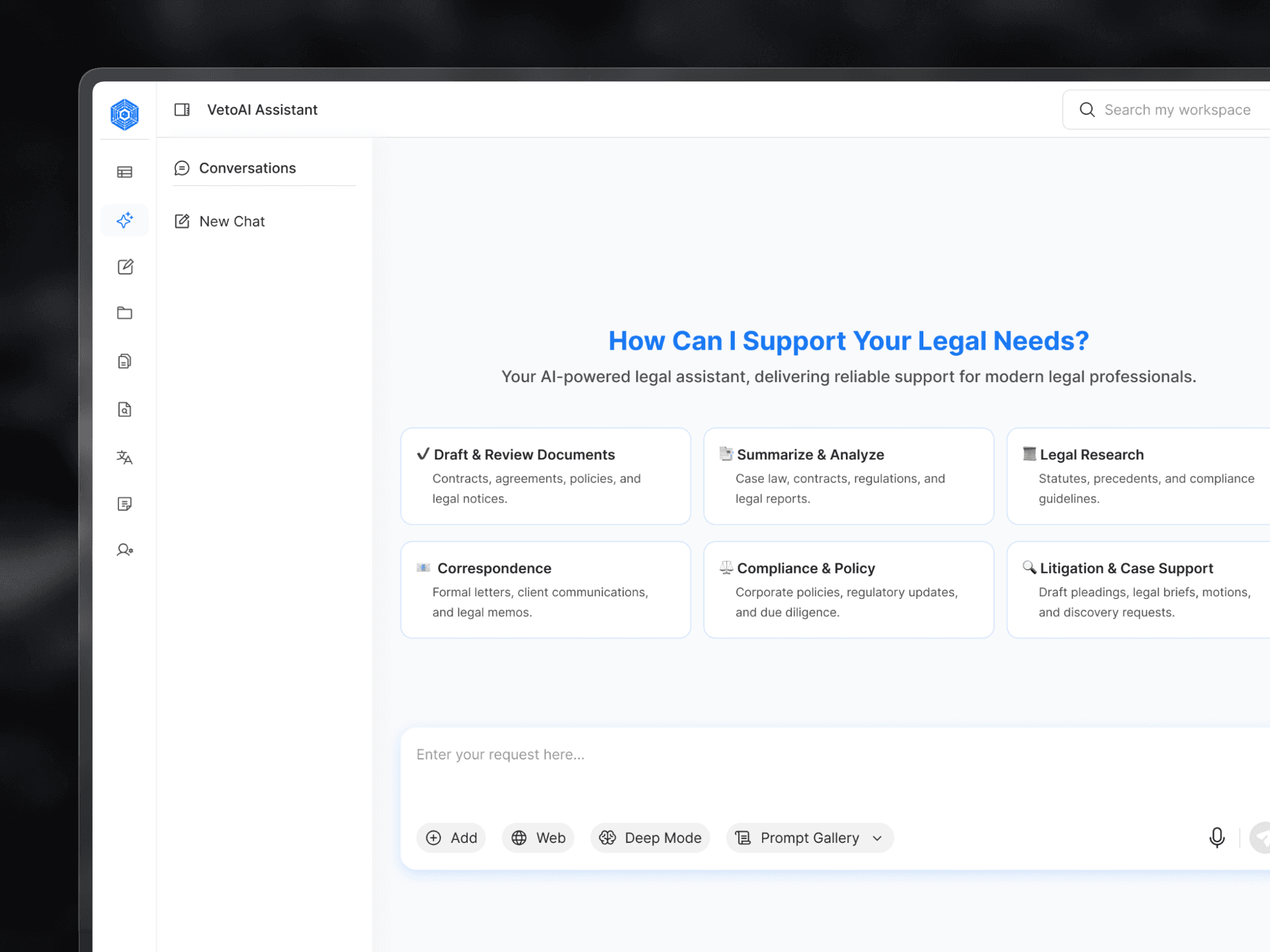
This 2026 guide shows you how to upgrade your AI legal research skills for Supreme Court litigation — and why modern platforms like VetoAI are redefining legal research in India.
Why AI Legal Research Skills Matter in Supreme Court Practice
Supreme Court litigation involves:
Constitutional interpretation
Multi-bench precedents
Conflicting High Court judgments
Ratio decidendi extraction
Citation verification
Traditional keyword search often leads to:
200+ irrelevant results
Missed binding precedents
Outdated citations
Time loss before final arguments
In contrast, AI legal research India 2026 focuses on:
Contextual case law analysis
Precedent mapping
Citation verification
Argument structuring
For advocates appearing in SLPs, writ petitions under Article 32, or constitutional bench matters, speed + accuracy = courtroom advantage.
Step 1: Master Prompt-Based Legal Research (Not Just Keyword Search)
Most lawyers still search like this: “Article 14 arbitrariness case”
That’s outdated. AI-powered platforms like VetoAI allow natural language research:
“Find Supreme Court judgments where Article 14 was invoked against arbitrary state action in tender allocation matters after 2015.”
This produces:
Narrowed, contextual results
Bench strength clarity
Extracted legal principles
Summarised ratio
Unlike database-only tools , AI-based research reduces manual filtering.
Step 2: Learn Ratio Decidendi Extraction Using AI
Supreme Court practice requires understanding:
What was actually decided?
What was obiter?
What is binding under Article 141?
Traditional research platforms provide full judgments — but extracting the ratio takes time.
Modern AI legal tools in India now:
Highlight key legal principles
Identify binding precedents
Map citation chains
Show how later benches treated earlier rulings
This is critical in constitutional matters and review petitions.
Improving your AI legal research skills means learning how to:
Ask for ratio summaries
Compare bench interpretations
Track precedent evolution
That’s where AI-powered legal analytics outperform static databases.
Step 3: Use AI for Citation Verification (Avoid Hallucination)
One major concern in 2026: AI hallucination in legal research.
Supreme Court drafting cannot afford fake citations.
Platforms like VetoAI are designed to:
Pull from verified Indian case law databases
Cross-check citations
Provide source-linked references
Reduce fabricated judgments
While tools Online provide reliable databases, they lack generative summarisation + verification layers that AI-native platforms are building.
Skill Upgrade:
Always verify:
Citation format
Bench strength
Subsequent overruling
Current legal position
This builds trust in court.
Step 4: Build AI-Assisted Legal Argument Structures
In Supreme Court litigation, your written submissions must be:
Structured
Precedent-backed
Logically layered
AI legal research skills now include:
Generating issue-wise case clusters
Creating argument flow from precedents
Identifying contradictory rulings
Suggesting persuasive structuring
Instead of manually assembling 25 cases, AI can:
Group cases by principle
Highlight strongest authorities
Show minority vs majority view
This is where AI legal research tools for Indian lawyers are creating competitive edge.
Step 5: Develop a 2026 Legal Research Workflow
Here’s a Supreme Court–ready AI workflow:
1️ - Define the Legal Issue - Frame precise constitutional or statutory question.
2️ - Use AI for Contextual Search - Use natural language prompts instead of fragmented keywords.
3️ - Extract Ratio + Bench Strength - Filter by constitutional bench vs division bench.
4️ - Verify Citation Status -Check if overruled, distinguished, or affirmed.
5️ - Draft With Precedent Mapping - Structure arguments backed by AI-identified strongest authorities.
This reduces research time by up to 50% compared to traditional database-only search.
VetoAI vs Online AI Legal (2026 Comparison),
Feature | Traditional Databases | VetoAI (AI-Native) |
|---|---|---|
Keyword Search | Yes | Yes |
Natural Language Query | Limited | Advanced(ALL) |
AI Case Summarisation | No | Yes |
Ratio Extraction | Manual | Automated |
Citation Verification | Yes | Yes |
Argument Structuring | No | Yes |
Hallucination Control | N/A | Designed for Legal Accuracy |
But Supreme Court practice in 2026 requires more than storage — it requires legal intelligence.
Common Mistakes Lawyers Make with AI Legal Research
❌ Blindly copying AI output
❌ Not verifying citations
❌ Using generic prompts
❌ Ignoring bench strength
❌ Not cross-checking overruling status
Improving AI legal research skills means combining:
Human legal reasoning + Verified AI assistance.
Future of AI in Supreme Court Litigation (2026 and Beyond)
The Indian judiciary is rapidly digitising. E-filing, virtual hearings, AI transcription — all becoming standard.
Advocates who master:
AI powered case law analysis India
Predictive legal analytics
Constitutional bench research automation
Citation mapping
…will dominate Supreme Court practice.
Final Takeaway: Upgrade Your Research Before Your Opponent Does
If you are practicing before the Supreme Court of India in 2026, improving your AI legal research skills is no longer optional.
AI-native platforms like VetoAI are building the next layer — verified, contextual, argument-ready legal intelligence.
The future of Supreme Court litigation belongs to advocates who combine:
Legal expertise
AI research precision
Verified precedent strategy
The question is not whether to use AI. The question is whether you are using it strategically.
Author :
Avika Grover
Innovator @VetoAI | Litigation & Dispute Resolution

Get started with legal AI
Ready to Work Smarter With Legal AI?