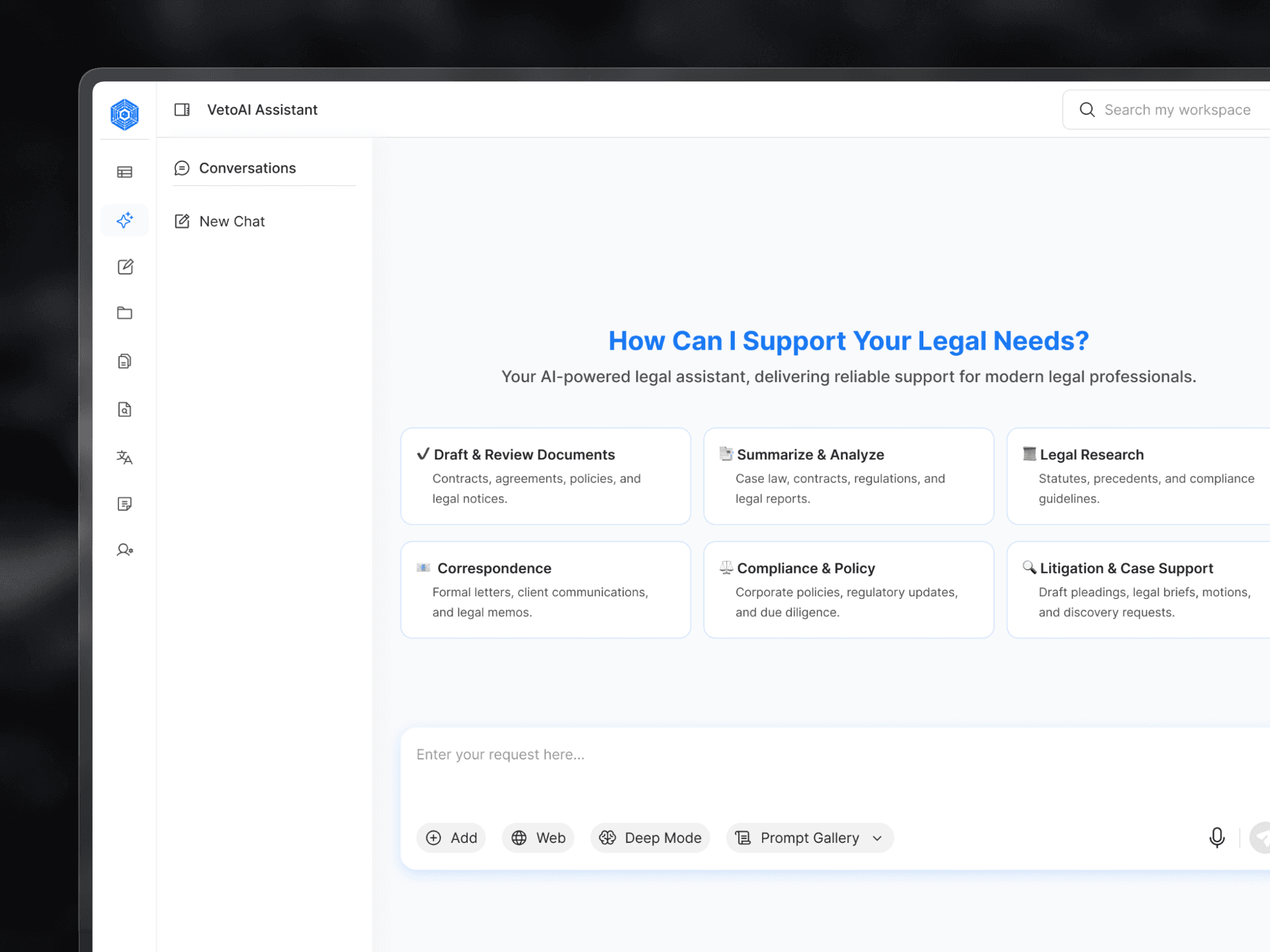
Legal Document Analysis
Legal Research Tools

The Indian legal profession is evolving faster than ever. With rising case backlogs, longer judgments, tighter timelines, and increasing client expectations, lawyers today are under constant pressure to do more in less time. Yet, many advocates and law firms still rely on traditional, manual workflows for case law research, drafting, and document translation.
This is where Legal AI is quietly transforming the way Indian lawyers work.
In 2026, legal practice is no longer just about knowing the law—it is about how efficiently you can access, analyse, and apply it. This blog explores how Legal AI simplifies case law research, drafting, and translation, and why Indian lawyers are increasingly adopting AI-powered legal tools like VetoAI.
The Core Problem: Traditional Legal Workflows Are Time-Heavy
Before understanding the solution, let’s acknowledge the pain points most Indian lawyers face daily:
Spending hours searching for relevant Supreme Court or High Court judgments
Reading through 100+ page judgments to extract one usable ratio
Reusing old drafts and manually editing clauses
Translating pleadings, contracts, or judgments between English and regional languages
Risk of missing important precedents or misinterpreting case law
These challenges don’t just waste time—they directly affect productivity, billing efficiency, and quality of legal work.
What Is Legal AI and Why It Matters for Indian Lawyers?
Legal AI refers to artificial intelligence systems trained specifically on legal data—judgments, statutes, rules, and legal language—to assist lawyers in research, drafting, summarisation, and translation.
Unlike general AI tools, Legal AI tools like VetoAI are built for Indian law, understanding court structures, legal terminology, and procedural context.
Legal AI doesn’t replace lawyers.
It removes repetitive work, allowing lawyers to focus on strategy, argument, and advocacy.
1. How Legal AI Simplifies Case Law Research
The Traditional Way
Multiple databases
Keyword guessing
Manual filtering
Skimming dozens of irrelevant results
The Legal AI Way
Legal AI tools transform case law research by:
Understanding legal intent, not just keywords
Fetching relevant, authoritative judgments faster
Highlighting key facts, issues, and ratios
Reducing research time from hours to minutes
With tools like VetoAI, Indian lawyers can:
Search judgments using plain legal questions
Quickly identify binding vs persuasive precedents
Access accurate summaries instead of full-length reading
This is especially valuable for litigators dealing with urgent matters, bail applications, or interim reliefs.
2. How Legal AI Makes Drafting Faster and More Accurate
Legal drafting is another area where lawyers lose valuable time.
Common Drafting Challenges
Rewriting similar clauses repeatedly
Maintaining tone and formatting consistency
Aligning drafts with latest case laws
Reviewing for legal clarity
How Legal AI Helps
Legal AI assists drafting by:
Generating structured legal drafts
Adapting language to Indian legal standards
Ensuring clarity, consistency, and precision
Saving hours spent on formatting and revisions
With VetoAI, lawyers can:
Draft pleadings, applications, notices, and contracts faster
Base drafts on current legal principles
Reduce dependency on outdated templates
This is particularly useful for junior advocates, law firm associates, and in-house legal teams handling high volumes of documents.
3. How Legal AI Simplifies Legal Translation
India’s legal system is multilingual. Lawyers frequently deal with documents in:
English
Hindi
Regional languages (Marathi, Tamil, Telugu, etc.)
The Risk with Manual Translation
Loss of legal meaning
Inaccurate terminology
Time-consuming review
Legal AI Translation Advantage
Legal AI tools are trained on legal language, not generic text. This ensures:
Context-aware translation
Preservation of legal intent
Faster turnaround without compromising accuracy
With VetoAI’s legal translation capabilities, lawyers can:
Translate judgments, pleadings, and contracts efficiently
Ensure consistency in legal terminology
Avoid misinterpretation that could impact a case
This is especially valuable for district court practice and multi-state litigation.
Why Indian Lawyers Are Adopting Legal AI in 2026
The shift towards Legal AI is driven by clear benefits:
Time Efficiency: Drastically reduces research and drafting time
Accuracy: minimizes human error in case law analysis
Competitive Advantage: Faster preparation, better arguments
Scalability: Handle more matters without increasing workload
Focus on Strategy: Less clerical work, more legal thinking
In a profession where time equals value, Legal AI is becoming indispensable.
Why VetoAI Stands Out for Indian Legal Professionals
Not all AI tools are built for law—and not all legal tools are built for India.
VetoAI is designed specifically for:
Indian courts and judgments
Indian legal language and drafting styles
Real problems faced by advocates and law firms
Whether it’s case law research, legal drafting, or translation, VetoAI integrates these workflows into one legal AI platform—making it practical, reliable, and lawyer-friendly.
The legal profession has always evolved—from handwritten pleadings to digital filings.
Legal AI is simply the next step.
Lawyers who adopt Legal AI today are not replacing their expertise—they are amplifying it.
In 2026, the question is no longer “Should lawyers use AI?”
It is “How long can lawyers afford not to?”
Ready to Experience Legal AI in Action?
If you’re an advocate, law firm, or legal professional looking to simplify case law research, drafting, and translation, now is the time to explore VetoAI.
👉 Try a free demo and see how Legal AI fits into your legal practice.
Author :
Avika Grover
Innovator @VetoAI | Litigation & Dispute Resolution

Get started with legal AI
Ready to Work Smarter With Legal AI?