VetoAI Law Firm
AI For Lawyers

Ask any in-house counsel in India what a typical day looks like, and the answer is rarely "strategic."
It often involves contract reviews, regulatory queries, non-disclosure agreements (NDAs), and dispute files that need urgent attention.
As companies grow and regulatory requirements become more complex, legal teams are expected to take on more responsibilities, often without a matching increase in headcount.
Artificial Intelligence (AI) is beginning to change how these teams manage their everyday work. By assisting with legal research, document analysis, and drafting, AI can reduce repetitive tasks and allow legal professionals to focus on judgement, risk assessment, and strategic business advice.
At VetoAI, we build AI tools for India's legal ecosystem. Let's explore the challenges faced by in-house legal teams, how AI can help address them, and how organisations can adopt it responsibly.
1. Understanding In-House Legal Teams
An in-house legal team consists of legal professionals employed directly by an organisation. Unlike external law firms, which are hired for specific matters, in-house counsel work closely with management and different departments.
Their responsibilities typically include:
Contract Management: Reviewing sales agreements, vendor contracts, NDAs, and other business agreements.
Legal Advisory: Providing guidance on business decisions, transactions, and legal matters.
Regulatory Compliance: Monitoring applicable laws, regulations, and policy changes.
Risk Management: Identifying potential legal risks and helping the organisation address them.
Dispute Management: Coordinating responses to notices, claims, and legal proceedings.
These responsibilities require both legal expertise and an understanding of business operations, making time management particularly important.
2. Key Challenges In-House Legal Teams Face
As organisations expand, their legal teams often encounter challenges that make everyday operations more demanding.
1. Growing Contract Volume
Sales agreements, vendor contracts, NDAs, and renewals all require careful review. When contract volume grows faster than the team, reviews can become a bottleneck.
2. An Expanding Compliance Load
Depending on the sector, companies must keep up with the Companies Act, FEMA, SEBI regulations, labour laws, and data protection requirements such as the Digital Personal Data Protection Act, 2023.
Tracking regulatory changes requires continuous attention.
3. Scattered Legal Records
Agreements and legal documents are often stored across email threads, shared drives, and scanned files. Finding an older agreement or checking a specific clause can take considerable time.
4. Tight Deadlines
Notices, deal deadlines, and regulatory queries often require quick responses. Legal teams must work efficiently without compromising accuracy.
Most of these challenges arise from the manual groundwork involved in handling large volumes of legal information.
3. How AI Supports In-House Legal Teams
AI tools can simplify several routine legal workflows by helping professionals search, analyse, and organise information more efficiently.
Here is how VetoAI supports these tasks:
1. AI Case Law Research
Search for relevant Supreme Court and High Court judgments and precedents.
Reduce the time spent on manual legal research.
Access source-linked references to locate and verify the underlying judgments.
2. Document Analysis and Summaries
Upload contracts, judgments, and case documents to your workspace.
Identify key facts, sections, and relevant legal insights.
Convert lengthy documents into structured summaries for easier review.
3. AI-Assisted Legal Drafting
Generate structured first drafts of notices, agreements, and petitions.
Use relevant legal citations to support the drafting process.
Review, edit, and adapt drafts to suit the organisation's requirements.
4. Timeline and List of Dates Generator
Extract important dates and events from legal documents.
Organise information into structured timelines and lists of dates.
Review and refine chronologies for disputes and legal proceedings.
5. OCR and Smart Document Processing
Convert scanned legal files and older agreements into searchable text.
Make it easier to locate specific clauses, dates, and details.
Reduce the effort involved in manually searching through scanned documents.
6. Questions Answered from Your Documents
Ask questions about documents uploaded to your workspace.
Receive contextual answers based on the available document content.
Use source-linked references to locate and verify the relevant information.
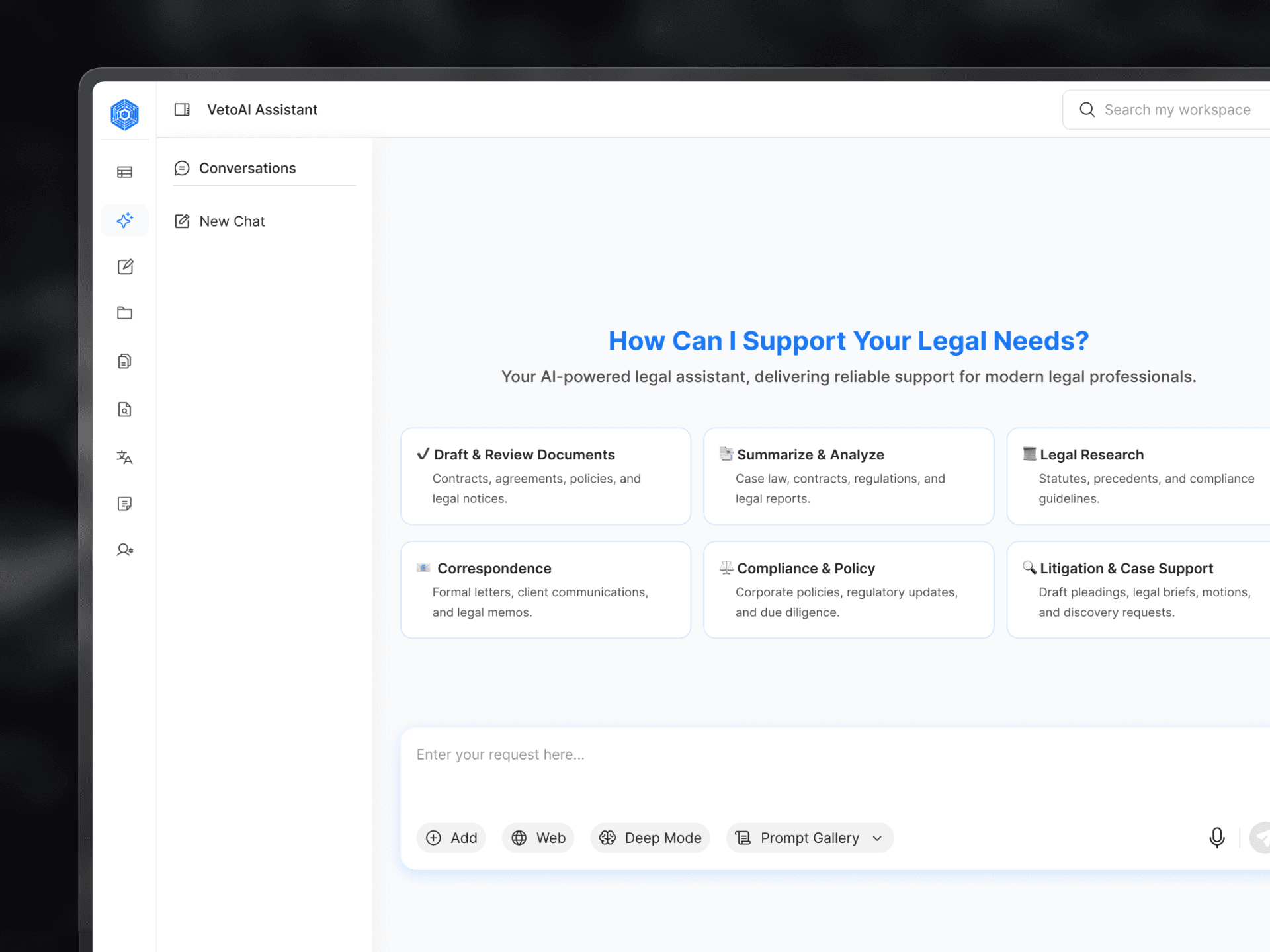
Together, these features help bring legal research, document analysis, and drafting into one workspace.
4. Benefits of AI for Corporate Legal Operations
When used effectively, AI can make everyday legal workflows more manageable.
1. Time Savings
Reduces manual effort in routine research, document review, and initial drafting.
2. Easier Access to Information
Helps legal teams retrieve clauses, dates, and details from lengthy documents more quickly.
3. Greater Transparency
Source-linked references make it easier to trace and verify information.
4. More Organised Workflows
Helps structure research, document analysis, and initial drafting.
5. More Time for Strategic Work
Allows legal professionals to focus on negotiations, risk assessment, and important business decisions.
5. Responsible Use of AI in Legal Work
While AI offers several advantages, it must be used carefully in legal environments.
1. Human Review Is Essential
AI-generated research, summaries, and drafts may contain errors. Qualified legal professionals must review and verify outputs before relying on them.
2. Verify Legal References
Case citations and legal information should be checked against authoritative sources, including official court records and relevant legislation.
3. Protect Confidential Information
Legal teams handle sensitive contracts, client information, and business records. Before adopting any AI platform, organisations should evaluate its security measures, access controls, and data-handling practices.
VetoAI states that it follows private and encrypted data-handling practices, offers enterprise-grade security, and does not use customer data to train its AI models.
The objective is to use AI as an assistant for legal work, while keeping interpretation, approval, and decision-making under human control.
6. How In-House Legal Teams Can Get Started with AI
Organisations do not need to transform every legal process at once. A gradual approach can make adoption easier.
Step 1: Identify Repetitive Tasks
Start with high-volume activities such as searching older agreements, reviewing documents, or preparing initial drafts.
Step 2: Run a Small Pilot
Choose an AI tool and test it with a specific workflow using appropriate documents and access controls.
Step 3: Evaluate the Results
Track time saved, output quality, accuracy, and feedback from the legal team.
Step 4: Expand Gradually
Once the team is comfortable with the tool, identify other workflows where AI assistance could be useful.
Involving legal professionals throughout the process also helps build trust and encourages responsible adoption.
Conclusion
In-house legal teams will always be valued for their judgement, legal expertise, and understanding of business operations.
AI does not replace these capabilities. Instead, it can reduce the time spent on routine groundwork and help professionals focus on decisions that require their expertise.
By bringing legal research, drafting, and document analysis into one workspace, VetoAI helps legal professionals simplify everyday tasks and support more efficient legal workflows.
Author :
Shreya Varma
Content & Digital Marketing Associate

Get started with legal AI
Ready to Work Smarter With Legal AI?